October 1, 2026 · BankOfGaga
How to Forgive a Family Loan Without Triggering IRS Gift Tax Penalties
Want to forgive a loan you made to your child? Discover how to use the annual gift tax exclusion under IRC § 2503(b) to wipe out debt legally without triggering IRS Form 709 penalties.

A few years ago, you stepped in to help your kid. Maybe it was twenty grand to help them buy their first house, help with college tuition, or help them get back on their feet after a rough patch.
You sat down, agreed on a reasonable monthly payment, and they’ve been doing their best to send you a check or Venmo every month like clockwork.
Now, things are looking up. Maybe they just had your first grandchild. Maybe Christmas is around the corner. Or maybe you looked at your own retirement savings and realized: “They’ve worked hard, they’ve proven their responsibility, and I just want to relieve them of the rest.”
You want to wipe the slate clean and tell them, “You don’t owe me another dime.”
It’s one of the greatest feelings in the world as a parent. But before you pick up the phone or text them “Hey, don’t worry about the rest of the loan!”—take a quick breath.
The IRS has a few peculiar rules about forgiving loans. If you just wave your hand on a handshake, the tax man can count that canceled balance as a taxable gift, or worse, count it as taxable income for your child.
Here is the simple, down-to-earth guide on how parents wipe out a family loan, understand how to forgive a family loan tax implications, protect their child from penalties, and preserve the dignity of family relationships.
Why a Casual “Forget About It” Can Backfire
Most parents assume that because it’s their own hard-earned money, whatever happens between them and their kids is nobody else’s business.
Under normal circumstances, that’s true. But when you officially cancel a debt, the government takes a keen interest.
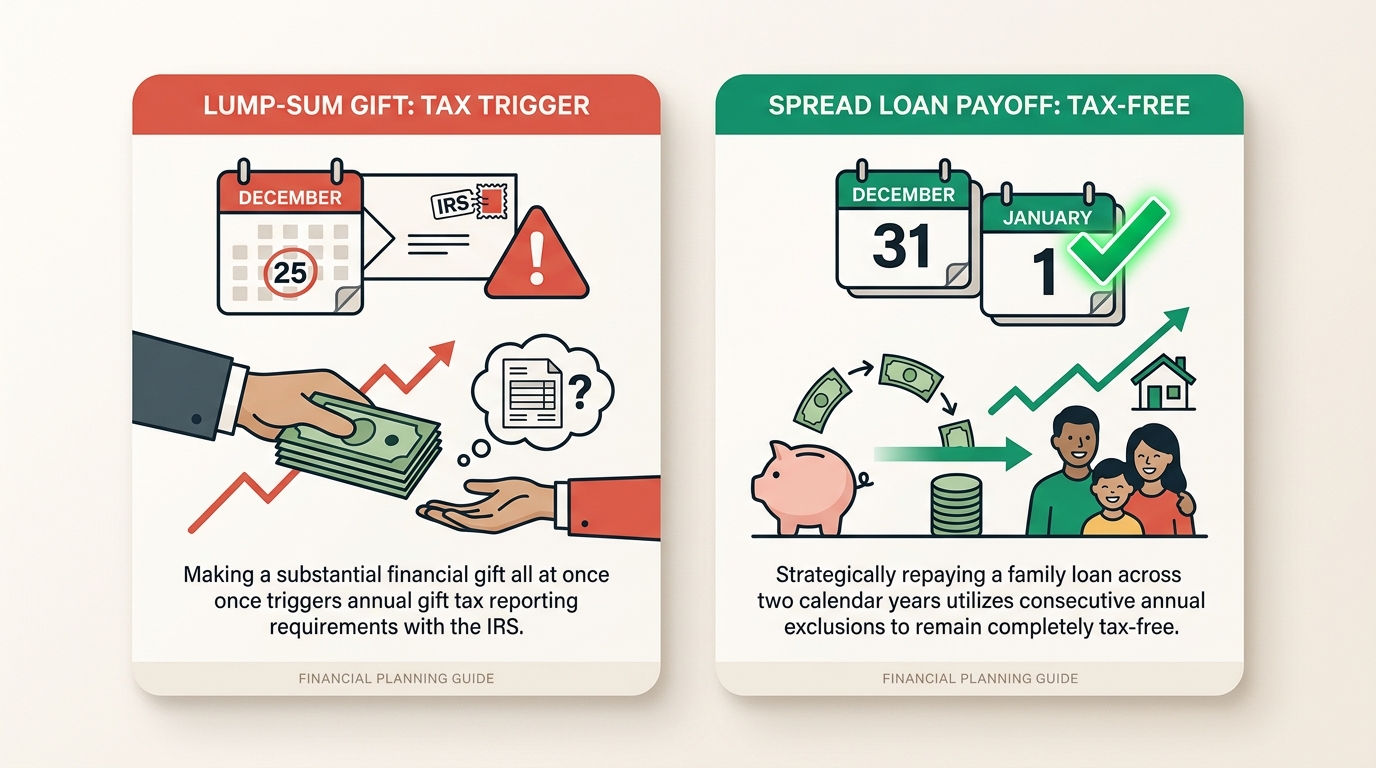
Trap 1: The IRS Gift Tax Trap (Form 709)
The IRS views forgiving a loan exactly the same as handing someone a stack of cash. In tax terms, canceling a debt is considered a gift.
Now, the good news: the government gives every taxpayer an Annual Gift Tax Exclusion ($18,000 per person per year, or $36,000 for a married couple). You can give anyone that amount every single calendar year without paying a penny in tax or having to file any paperwork.
Here’s where parents get tripped up:
Say your child still owes you $50,000. If you cancel all $50,000 in one afternoon, you blow right past the $18,000 limit (or $36,000 if you’re married).
That doesn’t mean you’ll suddenly owe thousands of dollars in taxes—most people never pay gift taxes thanks to the massive lifetime exemption. But it does legally require you to hire an accountant and file IRS Form 709. Skip that form, and you risk statutory penalties and an audit into your family’s private finances.
Trap 2: The "Phantom Income" Trap for Your Kid
If your original loan wasn’t clearly written down, or if the IRS decides the cancellation looks like "Cancellation of Debt" rather than a loving family gift, federal law (IRC § 108) treats that forgiven money as ordinary taxable income to your child.
Imagine trying to do something wonderful for your kid, only for them to get a surprise tax bill in April because the IRS counted your generosity as taxable income!
The Smart Parent Playbook: The Two-Year Holiday Split
You don't need a high-priced estate attorney to avoid these traps. You just need a calendar.
Instead of forgiving a large balance on a single day, you spread the forgiveness across the IRS annual limits.
How Much You Can Forgive Completely Tax-Free:
- If you’re on your own: You can forgive up to $18,000 per child every calendar year with zero forms to file.
- If you and your spouse are married: You can combine your allowances and forgive up to $36,000 per child every year.
- If your child is married: You and your spouse can forgive gifts to both your child and their spouse—up to $72,000 per year ($18,000 × 4) with zero taxes and zero paperwork!
The "New Year's Eve" Strategy
Suppose your daughter Sarah has a remaining balance of $45,000 on her down payment loan. You and your spouse want to forgive the whole thing.
- Step 1: On December 28th, you forgive $36,000. That sits squarely inside your current year’s exclusion.
- Step 2: On January 2nd (a brand-new tax year), you forgive the remaining $9,000.
In less than a week, Sarah’s loan is completely gone. Neither of you owes a nickel in tax, and neither of you has to file a single extra form with the IRS.
The One Golden Rule: Never Promise Forgiveness in Advance
There is one big mistake parents must avoid: Do not write in your original loan agreement that you plan to forgive the loan every year.
If you write: "Mom and Dad will loan you $50,000, and we promise to forgive $18,000 every Christmas," the IRS considers the entire agreement a "sham loan."
Tax court judges will rule that you gave them a $50,000 gift on Day 1, slap you with back penalties, and disallow the annual exclusion.
The right way to do it:
- Make the loan real from day one: Have a written note with clear terms and a fair interest rate at or above the official IRS Applicable Federal Rate (AFR).
- Have them make real payments: Let them build the habit of paying you back.
- Make forgiveness an independent choice: When you decide to forgive a balance, make it a joyful, surprise gift for that specific year—not a contractual promise you made years ago.
How to Wipe the Slate Clean in 4 Simple Steps
When you're ready to forgive a balance, don't rely on a casual text message. Follow these four simple steps to keep everything neat, clean, and audit-proof:
1. Check the Remaining Balance and Interest
Take a quick look at your payment records. Make sure you know the exact principal remaining and any interest that has accrued up to that date. (You can check statutory interest benchmarks using our free BankOfGaga AFR Calculator.)
2. Put a 1-Page "Gift Acknowledgment" in Your Files
Write a simple, one-page letter stating:
- The date and the original loan date.
- The exact amount being forgiven.
- A clear statement that the forgiven amount is an unconditional family gift given out of love and affection.
- The new balance remaining (or confirmation that the loan is Paid in Full).
Both you and your child should keep a copy in your records.
3. Mark the Balance Paid in Your Shared Account
If your child ever applies to buy a new home, refinance their mortgage, or apply for a business loan, bank underwriters will scrutinize their bank statements.
Having a clear digital statement showing the loan was formally marked paid protects their debt-to-income ratio and prevents lenders from asking awkward questions about "unpaid family debts."
4. Hand Them the Original Note Marked "Paid in Full"
If the loan is 100% forgiven, write "PAID IN FULL & CANCELLED" across the original promissory note, sign it, and hand it back to your child. It's a wonderful, symbolic moment that honors their effort and your generosity.
Why Keeping It Clean Keeps Family Dinners Drama-Free
Money between family members is rarely just about the math. It's about emotions, pride, and peace of mind.
When a family loan is left hanging or canceled without clear records:
- Siblings might wonder if one child got special favoritism behind closed doors.
- Adult kids can feel lingering guilt or uncertainty about whether they still "owe" you something.
- Parents can inadvertently feel a twinge of resentment if the child seems unappreciative later on.
That’s why families across the country use BankOfGaga:
- Clear, Shared Ledgers: Both you and your child see every payment, every interest calculation, and every gift credit in real-time.
- Legal Promissory Notes: Generate clean, IRS-compliant agreements in 2 minutes using our free Promissory Note Generator.
- Automated Peace of Mind: Everything is documented, audit-proof, and professional—so money never gets in the way of family, and Thanksgiving stays Thanksgiving.
Ready to set up or wrap up your family money agreement the right way? Start your 14-Day Free Trial at BankOfGaga today.