July 2, 2026 · BankOfGaga
Mortgage Gift Letter vs. Family Loan: How to Help Your Kid Buy a House
Helping your child buy a home? Learn the difference between a mortgage gift letter and a family loan, and how to satisfy bank underwriters and the IRS.
Helping a child buy their first home is one of the most rewarding milestones a parent can participate in. With home prices and mortgage rates remaining high, a parent’s assistance with the down payment is often the only way a young buyer can get their offer accepted.
But when you transfer money to your child's bank account for a home purchase, the bank’s mortgage underwriter will immediately flag the deposit. They will ask a critical question: Is this money a gift, or is it a loan?
How you answer this question matters. Get it wrong, and you could delay the closing, disqualify your child from the mortgage, or unintentionally commit mortgage fraud.
Here is the difference between a mortgage gift letter and a family loan, and how to structure your help legally and successfully.
1. What is a Mortgage Gift Letter?
If you want to give your child the down payment cash with no expectation of repayment, the mortgage lender will require you to sign a Gift Letter.
A gift letter is a simple, one-page document provided by the bank. It states:
- The donor's relationship to the buyer (must be a relative).
- The exact amount of the money transferred.
- A clear, explicit statement that no repayment is expected or implied.
The bank requires this because they want to ensure that the down payment is actually your child’s equity. If there is any chance you expect the money back, the bank treats that expectation as a debt—which changes the math on the mortgage.
2. What is a Family Loan (Second Mortgage)?
If you want your child to pay you back over time, the money is a loan, not a gift.
You can absolutely structure your down payment assistance as a family loan, but you must disclose it to the mortgage lender.
If you set up a family loan for the down payment, the mortgage underwriter will:
- Require a written agreement: You must provide the signed promissory note showing the interest rate and repayment terms.
- Calculate the DTI (Debt-to-Income) ratio: The bank will count the monthly payment of your family loan as an active monthly debt for your child. If this payment pushes their DTI ratio above the bank's limit (usually 43% to 50%), the mortgage will be denied.
If your child has strong income but lacks savings, a disclosed family loan can work beautifully. But if their debt-to-income ratio is already tight, the bank may require the funds to be a pure gift.
3. The Danger of the "Silent Loan" (Mortgage Fraud)
To avoid the DTI calculation, some families are tempted to tell the mortgage lender the money is a gift (signing a gift letter), while privately agreeing that the child will pay it back.
Do not do this.
Signing a gift letter while expecting repayment is a federal offense known as mortgage fraud. Underwriters audit bank accounts, tax returns, and transfers. If they discover regular monthly payments from the child to the parent after closing, the bank can call the loan due immediately, and the legal consequences are severe.
If the money must be repaid, it must be disclosed as a loan. If it is a gift, it must be a true gift.
4. How to Make a Disclosed Family Loan Work
If you choose the family loan route and your child’s DTI allows it, follow these steps to keep the underwriting process smooth:
- Get pre-approved early: Talk to the mortgage loan officer before signing any purchase contract. Tell them you plan to structure a family loan for the down payment so they can build it into the pre-approval math.
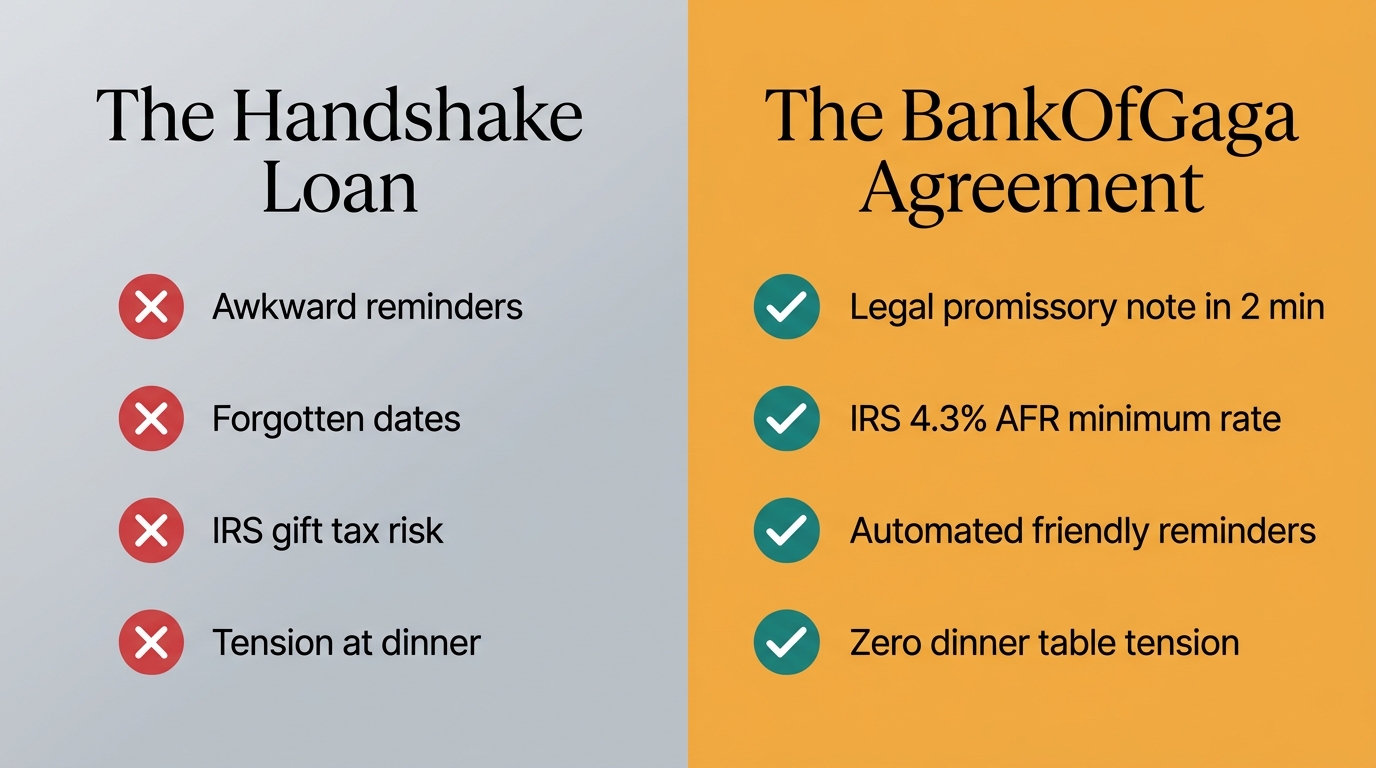
- Use the IRS AFR Minimum: Charge interest at or above the Applicable Federal Rate (AFR) using our free IRS AFR Calculator so the IRS does not classify the loan interest as a gift.
- Use a Formal Agreement: Generate a compliant document in 2 minutes with our Promissory Note Generator.
- Keep a clean, documented ledger: The bank underwriter may want to see that the loan is serviced via a clean, professional platform once the mortgage closes.
BankOfGaga builds professional amortization schedules, handles the AFR rate requirements, and keeps a clear, shared ledger that satisfies tax and lending records. It makes family loans transparent for the IRS, the bank, and your family. Try it free for 14 days →